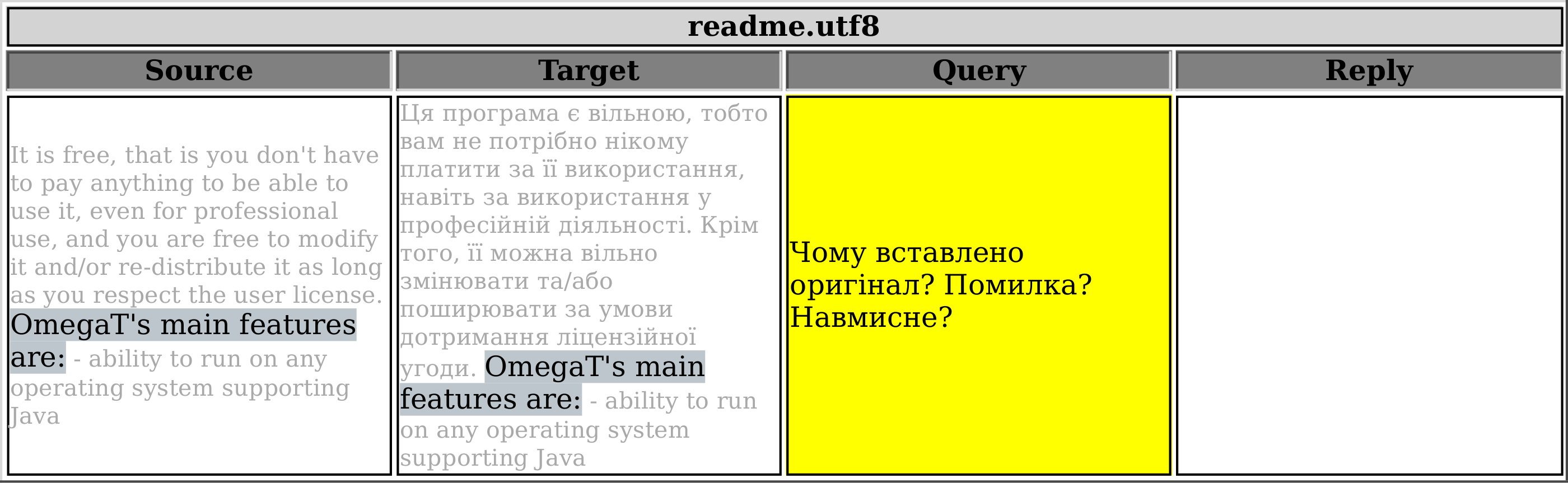
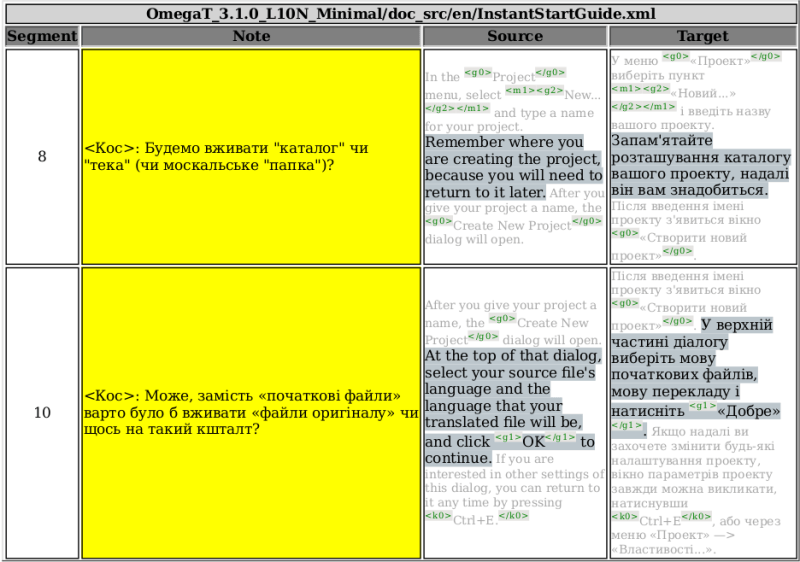
This script is variation of the one published before that exports all notes in the current project. The only difference is that this one allows you to select which notes will get exported based on the first line of the note. The resultant HTML table will consist of four columns: Source, Target, Filtered Notes (adjustable heading name), and Reply.
Say, you want to be able to export only the notes that start with <query>, as you’ve been using this word (<query>) to mark your questions to the client. In order to do so, go to line 14 and specify which mark-word was used. Note: The mark-word used to filter notes should be found in the very beginning of the very first line of the note, otherwise it’ll be ignored. In line 15 you can specify the column heading.
Category Archives: groovy
Export #OmegaT Project Notes
Here’s a new script that lets you export OmegaT project notes to a HTML table. It may help you to discuss different translation issues with the client/editor/your spiritual guru or review your own translation if you use notes for yourself.
When the script is invoked, it will create a file named PROJECTNAME_notes.html in /script_output subfolder of the current project root (the subfolder will be created if it doesn’t exist, and PROJECTNAME is the actual name, of course).
Convert OmegaT project to XLIFF for other CAT tools
I’m back with another little script that might be pretty handy for those who need to work on the same material in different CAT tools, or for translation agencies who use OmegaT as their main CAT application but farm out the work to translators using their CAT tools of choice. As a matter of fact, the script was requested by translation agency Velior for this very reason.
When the script is invoked, it writes out a file named PROJECTNAME.xlf (PROJECTNAME is the actual name of the project, not this loudly yelled word, of course), and the file is located in script_output subfolder of the current project. It exports both translated (they get “final” state in the resultant XLF file) and untranslated segments, and for untranslated segments the source is copied to the target, and such segments get “needs-translation” state. OmegaT segmentation and tags are preserved. Tags get enveloped in <ph id=”x”> and </ph>, so that they are treated as tags in other CAT tools. Continue reading
Insert Custom Tag-like Strings in OmegaT
This is a little article on how to semi-automatically insert context-dependent custom strings in OmegaT. To illustrate what I mean, I give a little example from the kind of work I get to do pretty often. Continue reading
Export OmegaT Project to HTML table
Here’s a script that lets you export your whole OmegaT project into an HTML file with one or more tables, one for each source file. The left column will have source segments, and the right will be either blank if the segment isn’t translated, or populated with translation (or , if translation was set to be empty). Each table will have source file name for its heading. The script was requested and kindly sponsored by Roman Mironov at Translation Agency Velior. As usual, in the below listing the heading is a link to pastebin.com where you can download this script. Continue reading
Export relavant TU’s from legacy TMX files in OmegaT
Situation
You have a new project and legacy translation memory files that usually go to /tm folder of OmegaT project. You need to give this project to someone else, but you don’t want to give away all of your previous translation. Somehow you need to extract from your TMX files only those TU’s that have matches in the current project.
Problem
The problem is evident — you need OmegaT to get matches for each segment, and if they are any good, store them somewhere handy, in a separate TMX file.
The problem has been (or still is) discussed on OmegaT Yahoo Group.
Solution
lame GUI update to the new TMX export
This is an update to the previous post about exporting new translations to a TMX.
The script doesn’t have a GUI to select date and time or to specify whether it should work globally or on selected files. This update still doesn’t have that GUI, but provides for an external program to fill that gap. In this post I’m sharing the updated groovy script and a simple bash+zenity wizard-like script for Linux that acquires necessary data.
If no such external program/script exists, the groovy script continues to work as before without any extra fuss.
-
write_new_trans2TMX_extGUI.groovy
/* * Purpose: Export new translations completed after the specified * date (line 21) either for the entire project or for the * selected files ("select_files" must be set to 'yes' — line 27) * to TMX file * #Files: Writes 'translated_after_<date_time>.tmx' * in the current project's root * #File format: TMX v.1.4 * #Details: http:/ /wp.me / p3fHEs-6z * * @author Kos Ivantsov * @date 2013-08-12 * @version 0.3 */ /* * The date should be specified as "year-month-day HOURS:minutes" * If not specified or specified wrongly, the script will look for * translations that are newer than one day. */ def newdate = '' /* * Set "select_files" to 'yes' if you want to use file selector * to specify files for export. If anything else is specified, the script * will work with the complete project. */ select_files = '' import javax.swing.JFileChooser import org.omegat.util.StaticUtils import org.omegat.util.TMXReader import static javax.swing.JOptionPane.* import static org.omegat.util.Platform.* def prop = project.projectProperties if (!prop) { final def title = 'Export new translation' final def msg = 'Please try again after you open a project.' showMessageDialog null, msg, title, INFORMATION_MESSAGE return } /* * If you want to use an external date and time selector and a window to * ask whether you want to select individual files, specify the whole path * to that program/script. It should print out date in the proper format * on the first line of the stout, and "yes" or anything else on the second * line. */ def command = "/home/user/.omegat/script/new2tmx_tweak" try { proc = command.execute() proc.waitFor() //console.println "${proc.in.text}" def lines = "${proc.in.text}".readLines() newdate = lines[0] select_files = lines[1] } catch(java.io.IOException ex){ if (ex.getMessage() =~ 'error=13'){ console.println "The program is not executable" } if (ex.getMessage() =~ 'error=2'){ console.println "The program is not found" } } try { newdate = new Date().parse("yyyy-MM-dd HH:mm", newdate) } catch (java.text.ParseException e) { newdate = new Date().minus(1) final def title = 'Wrong date format' final def msg = """\ The date has been specified in a wrong format. The script will work with entries exactly one day old, i.e. changed after $newdate\ """ console.println msg showMessageDialog null, msg, title, INFORMATION_MESSAGE } namedate = new Date().parse("E MMM dd H:m:s z yyyy", newdate.toString()).format("MMM-dd-yyyy_HH.mm") def fileloc = prop.projectRoot+'translated_after_'+namedate+"${ (select_files == 'yes') ? "_select" : ''}"+'.tmx' exportfile = new File(fileloc) if (prop.isSentenceSegmentingEnabled()) segmenting = TMXReader.SEG_SENTENCE else segmenting = TMXReader.SEG_PARAGRAPH def sourceLocale = prop.getSourceLanguage().toString() def targetLocale = prop.getTargetLanguage().toString() exportfile.write("", 'UTF-8') exportfile.append("<?xml version=\"1.0\" encoding=\"UTF-8\"?>\n", 'UTF-8') exportfile.append("<!DOCTYPE tmx SYSTEM \"tmx11.dtd\">\n", 'UTF-8') exportfile.append("<tmx version=\"1.4\">\n", 'UTF-8') exportfile.append(" <header\n", 'UTF-8') exportfile.append(" creationtool=\"OmegaTScripting\"\n", 'UTF-8') exportfile.append(" segtype=\"" + segmenting + "\"\n", 'UTF-8') exportfile.append(" o-tmf=\"OmegaT TMX\"\n", 'UTF-8') exportfile.append(" adminlang=\"EN-US\"\n", 'UTF-8') exportfile.append(" srclang=\"" + sourceLocale + "\"\n", 'UTF-8') exportfile.append(" datatype=\"plaintext\"\n", 'UTF-8') exportfile.append(" >\n", 'UTF-8') def hitcount = 0 if ((select_files == 'yes')) { srcroot = new File(prop.getSourceRoot()) sourceroot = prop.getSourceRoot().toString() as String JFileChooser fc = new JFileChooser( currentDirectory: srcroot, dialogTitle: "Choose files to export", fileSelectionMode: JFileChooser.FILES_ONLY, //the file filter must show also directories, in order to be able to look into them multiSelectionEnabled: true) if(fc.showOpenDialog() != JFileChooser.APPROVE_OPTION) { console.println "Canceled" return } if (!(fc.selectedFiles =~ sourceroot.replaceAll(/\\+/, '\\\\\\\\'))) { console.println "Selection outside of ${prop.getSourceRoot()} folder" final def title = 'Wrong file(s) selected' final def msg = "Files must be in ${prop.getSourceRoot()} folder." showMessageDialog null, msg, title, INFORMATION_MESSAGE return } fc.selectedFiles.each { fl = "${it.toString()}" - "$sourceroot" exportfile.append(" <prop type=\"Filename\">" + fl + "</prop>\n", 'UTF-8') } exportfile.append(" </header>\n", 'UTF-8') exportfile.append(" <body>\n", 'UTF-8') fc.selectedFiles.each{ fl = "${it.toString()}" - "$sourceroot" files = project.projectFiles files.each{ if ( "${it.filePath}" != "$fl" ) { println "Skipping to the next file" }else{ it.entries.each { def info = project.getTranslationInfo(it) def changeId = info.changer def changeDate = info.changeDate def creationId = info.creator def creationDate = info.creationDate def alt = 'unknown' if (info.isTranslated()) { if (newdate.before(new Date(changeDate))){ hitcount++ source = StaticUtils.makeValidXML(it.srcText) target = StaticUtils.makeValidXML(info.translation) exportfile.append(" <tu>\n", 'UTF-8') exportfile.append(" <tuv xml:lang=\"" + sourceLocale + "\">\n", 'UTF-8') exportfile.append(" <seg>" + "$source" + "</seg>\n", 'UTF-8') exportfile.append(" </tuv>\n", 'UTF-8') exportfile.append(" <tuv xml:lang=\"" + targetLocale + "\"", 'UTF-8') exportfile.append(" changeid=\"${changeId ?: alt }\"", 'UTF-8') exportfile.append(" changedate=\"${ changeDate > 0 ? new Date(changeDate).format("yyyyMMdd'T'HHmmss'Z'") : alt }\"", 'UTF-8') exportfile.append(" creationid=\"${creationId ?: alt }\"", 'UTF-8') exportfile.append(" creationdate=\"${ creationDate > 0 ? new Date(creationDate).format("yyyyMMdd'T'HHmmss'Z'") : alt }\"", 'UTF-8') exportfile.append(">\n", 'UTF-8') exportfile.append(" <seg>" + "$target" + "</seg>\n", 'UTF-8') exportfile.append(" </tuv>\n", 'UTF-8') exportfile.append(" </tu>\n", 'UTF-8') } } } } } } } else { exportfile.append(" </header>\n", 'UTF-8') exportfile.append(" <body>\n", 'UTF-8') files = project.projectFiles files.each { it.entries.each { def info = project.getTranslationInfo(it) def changeId = info.changer def changeDate = info.changeDate def creationId = info.creator def creationDate = info.creationDate def alt = 'unknown' if (info.isTranslated()) { if (newdate.before(new Date(changeDate))){ hitcount++ source = StaticUtils.makeValidXML(it.srcText) target = StaticUtils.makeValidXML(info.translation) exportfile.append(" <tu>\n", 'UTF-8') exportfile.append(" <tuv xml:lang=\"" + sourceLocale + "\">\n", 'UTF-8') exportfile.append(" <seg>" + "$source" + "</seg>\n", 'UTF-8') exportfile.append(" </tuv>\n", 'UTF-8') exportfile.append(" <tuv xml:lang=\"" + targetLocale + "\"", 'UTF-8') exportfile.append(" changeid=\"${changeId ?: alt }\"", 'UTF-8') exportfile.append(" changedate=\"${ changeDate > 0 ? new Date(changeDate).format("yyyyMMdd'T'HHmmss'Z'") : alt }\"", 'UTF-8') exportfile.append(" creationid=\"${creationId ?: alt }\"", 'UTF-8') exportfile.append(" creationdate=\"${ creationDate > 0 ? new Date(creationDate).format("yyyyMMdd'T'HHmmss'Z'") : alt }\"", 'UTF-8') exportfile.append(">\n", 'UTF-8') exportfile.append(" <seg>" + "$target" + "</seg>\n", 'UTF-8') exportfile.append(" </tuv>\n", 'UTF-8') exportfile.append(" </tu>\n", 'UTF-8') } } } } } exportfile.append(" </body>\n", 'UTF-8') exportfile.append("</tmx>", 'UTF-8') final def title = 'TMX file written' final def msg = "$hitcount TU's written to " + exportfile.toString() console.println msg showMessageDialog null, msg, title, INFORMATION_MESSAGE returnThe only difference compared to the previous version is lines 43-66. The external program is specified in line 50.
- new2tmx_tweak
#!/bin/bash DATE=$(zenity --calendar \ --title "Select date" \ --text="TU's newer than the selected date will be used for export" \ --date-format=%F) HRS=({00..24}) MINS=({00..59}) HRS=$(zenity --entry --title "Select time" \ --text="Hours" \ --entry-text="${HRS[@]}" ) MINS=$(zenity --entry --title "Select time" \ --text="Minutes" \ --entry-text="${MINS[@]}" ) zenity --question --title="Select Files" \ --text="Do you want to select individual files for export?" if [ $? == "0" ]; then FILESEL='yes' else FILESEL='no' fi echo "$DATE $HRS:$MINS" echo $FILESELThis script should be saved somewhere (in this example it’s /home/user/.omegat/script/new2tmx_tweak) and made executable (
chmod +x /home/user/.omegat/script/new2tmx_tweak). Zenity should be installed for it to work. One can cook up a nicer GUI using other tools, of course, but this serves just as a quick example. I guess, similar can be done using AutoIt or AutoHotKey on MS Windows or AppleScript on OSX.
If you happen to come up with your own date and time picker for this, feel free to share in comments or link to your solution.
But as of now,
Good luck!
Export TMX for new translations
Here’s a script that lets you export translation units that are newer than a specified date. It might be useful if you get a project with a legacy TMX containing some perfect matches (that memory should be put into /tm/auto), and you want to be able to run QA tests only on new TU’s that have been translated since you’ve started to work on the project, or you want to keep your own translations for later and don’t really care for what has been translated before.
If the script is invoked without changing or specifying anything, it looks for TU’s that are one day old and works globally on the whole project. If you need to filter TU’s older or newer than that, you’ll have to specify the date on line 21.
The date should be in “yyyy-MM-dd HH:mm” (4_digit_year-2_digit_month-2_digit_day space 2_digit_hour_in_military_notation:2_digit_minute) format. If not specified properly, it will fall back to the default one-day-old value.
Beside that, the user can specify whether the script should work globally on the entire project, or only on selected files. To enable file selection, the line 27 should read:
select_files = 'yes'
Anything other than ‘yes’ means the script will work globally. Continue reading
Export TMX for selected files
OmegaT exports TMX for current files in the project every time translated documents are created. It writes three TMX files in the root of the project. But what if you need a translation memory file that contains translation units of only one or several files, not all that are currently present in the project. One solution is to temporarily move unneeded files out of source folder, reload the project and then create translated documents. But it is somewhat awkward and time consuming.
Here’s a groovy script that lets you select one or several files located in the same subfolder of the current project’s /source. Once they are selected, the script writes selected_files.[date_time].tmx in the project root. This TMX-file contains TU’s only for the selected files.
- write_sel_files2TMX.groovy
/* * Purpose: Export source and translation segments of user selected * files into TMX-file * #Files: Writes 'selected_files_<date_time>.tmx' in the current project's root * #File format: TMX v.1.4 * #Details: http:/ /wp.me / p3fHEs-6g * * @author Kos Ivantsov * @date 2013-08-12 * @version 0.3 */ import javax.swing.JFileChooser import org.omegat.util.StaticUtils import org.omegat.util.TMXReader import static javax.swing.JOptionPane.* import static org.omegat.util.Platform.* def prop = project.projectProperties if (!prop) { final def title = 'Export TMX from selected files' final def msg = 'Please try again after you open a project.' showMessageDialog null, msg, title, INFORMATION_MESSAGE return } def curtime = new Date().format("MMM-dd-yyyy_HH.mm") srcroot = new File(prop.getSourceRoot()) def fileloc = prop.projectRoot+'selected_files_'+curtime+'.tmx' exportfile = new File(fileloc) def sourceroot = prop.getSourceRoot().toString() as String JFileChooser fc = new JFileChooser( currentDirectory: srcroot, dialogTitle: "Choose files to export", fileSelectionMode: JFileChooser.FILES_ONLY, //the file filter must show also directories, in order to be able to look into them multiSelectionEnabled: true) if(fc.showOpenDialog() != JFileChooser.APPROVE_OPTION) { console.println "Canceled" return } if (!(fc.selectedFiles =~ sourceroot.replaceAll(/\\+/, '\\\\\\\\'))) { console.println "Selection outside of ${prop.getSourceRoot()} folder" final def title = 'Wrong file(s) selected' final def msg = "Files must be in ${prop.getSourceRoot()} folder." showMessageDialog null, msg, title, INFORMATION_MESSAGE return } if (prop.isSentenceSegmentingEnabled()) segmenting = TMXReader.SEG_SENTENCE else segmenting = TMXReader.SEG_PARAGRAPH def sourceLocale = prop.getSourceLanguage().toString() def targetLocale = prop.getTargetLanguage().toString() exportfile.write("", 'UTF-8') exportfile.append("<?xml version=\"1.0\" encoding=\"UTF-8\"?>\n", 'UTF-8') exportfile.append("<!DOCTYPE tmx SYSTEM \"tmx11.dtd\">\n", 'UTF-8') exportfile.append("<tmx version=\"1.4\">\n", 'UTF-8') exportfile.append(" <header\n", 'UTF-8') exportfile.append(" creationtool=\"OmegaTScripting\"\n", 'UTF-8') exportfile.append(" segtype=\"" + segmenting + "\"\n", 'UTF-8') exportfile.append(" o-tmf=\"OmegaT TMX\"\n", 'UTF-8') exportfile.append(" adminlang=\"EN-US\"\n", 'UTF-8') exportfile.append(" srclang=\"" + sourceLocale + "\"\n", 'UTF-8') exportfile.append(" datatype=\"plaintext\"\n", 'UTF-8') exportfile.append(" >\n", 'UTF-8') fc.selectedFiles.each{ fl = "${it.toString()}" - "$sourceroot" exportfile.append(" <prop type=\"Filename\">" + fl + "</prop>\n", 'UTF-8') } exportfile.append(" </header>\n", 'UTF-8') exportfile.append(" <body>\n", 'UTF-8') def count = 0 fc.selectedFiles.each{ fl = "${it.toString()}" - "$sourceroot" files = project.projectFiles files.each{ if ( "${it.filePath}" != "$fl" ) { println "Skipping to the next file" }else{ it.entries.each { def info = project.getTranslationInfo(it) def changeId = info.changer def changeDate = info.changeDate def creationId = info.creator def creationDate = info.creationDate def alt = 'unknown' if (info.isTranslated()) { source = StaticUtils.makeValidXML(it.srcText) target = StaticUtils.makeValidXML(info.translation) exportfile.append(" <tu>\n", 'UTF-8') exportfile.append(" <tuv xml:lang=\"" + sourceLocale + "\">\n", 'UTF-8') exportfile.append(" <seg>" + "$source" + "</seg>\n", 'UTF-8') exportfile.append(" </tuv>\n", 'UTF-8') exportfile.append(" <tuv xml:lang=\"" + targetLocale + "\"", 'UTF-8') exportfile.append(" changeid=\"${changeId ?: alt }\"", 'UTF-8') exportfile.append(" changedate=\"${ changeDate > 0 ? new Date(changeDate).format("yyyyMMdd'T'HHmmss'Z'") : alt }\"", 'UTF-8') exportfile.append(" creationid=\"${creationId ?: alt }\"", 'UTF-8') exportfile.append(" creationdate=\"${ creationDate > 0 ? new Date(creationDate).format("yyyyMMdd'T'HHmmss'Z'") : alt }\"", 'UTF-8') exportfile.append(">\n", 'UTF-8') exportfile.append(" <seg>" + "$target" + "</seg>\n", 'UTF-8') exportfile.append(" </tuv>\n", 'UTF-8') exportfile.append(" </tu>\n", 'UTF-8') count++; } } } } } exportfile.append(" </body>\n", 'UTF-8') exportfile.append("</tmx>", 'UTF-8') final def title = 'TMX file written' final def msg = "$count TU's written to " + exportfile.toString() console.println msg showMessageDialog null, msg, title, INFORMATION_MESSAGE returnThe TMX file is rewritten each time the script in invoked.
Big thank you goes to Roman Mironov and Velior Translation Agency for the idea and comprehensive support.
Suggestions and comments are always welcome.
But as of now,
Good luck!
Write all source segments to a file
Update: Please, download scripts from the dedicated SF.net project page where they are maintained. Scripts at the links below might be obsolete (though most likely still working).
Since we started to make OmegaT write stuff to files, let’s try to dump all source segments to one file. I’m pretty sure one can find some use for it.
/*
* #Purpose: Write all source segments to a file
* #Files: Writes 'allsource.txt' in the current project's root
*
* @author: Kos Ivantsov
* @date: 2013-07-16
* @version: 0.2
*/
/* change "includefilenames" to anything but 'yes' (with quotes)
* if you don't need filenames to be included in the file */
def includefilenames = 'no'
def includerepetitions = 'no'
import static javax.swing.JOptionPane.*
import static org.omegat.util.Platform.*
// abort if a project is not opened yet
def prop = project.projectProperties
if (!prop) {
final def title = 'Source to File'
final def msg = 'Please try again after you open a project.'
showMessageDialog null, msg, title, INFORMATION_MESSAGE
return
}
def folder = prop.projectRoot+'/script_output'
def fileloc = folder+'/allsource.txt'
writefile = new File(fileloc)
if (! (new File(folder)).exists()) {
(new File(folder)).mkdir()
}
writefile.write("", 'UTF-8')
def count = 0
def uniqline
if (includefilenames == 'yes') {
files = project.projectFiles;
for (i in 0 ..< files.size())
{
fi = files[i];
marker = "+${'='*fi.filePath.size()}+\n"
writefile.append("$marker|$fi.filePath|\n$marker", 'UTF-8')
for (j in 0 ..< fi.entries.size())
{
ste = fi.entries[j];
source = ste.getSrcText();
writefile.append source +"\n", 'UTF-8'
count++;
}
}
} else {
project.allEntries.each { ste ->
source = ste.getSrcText();
writefile.append source+"\n",'UTF-8'
count++
}
console.println "$count segments found in all files"
if (includerepetitions != 'yes') {
count = 0
uniqline = writefile.readLines().unique()
//console.println uniqline
writefile.write("",'UTF-8')
uniqline.each {
writefile.append "$it\n\n",'UTF8';
count++
}
}
}
console.println count +" segments written to "+ writefile
final def title = 'Source to File'
final def msg = count +" segments"+"\n"+"written to \n"+ writefile
showMessageDialog null, msg, title, INFORMATION_MESSAGE
return
Once the script is invoked, it’ll create a file named “allsource.txt” in the current project’s root folder, where each segment will be on a new line. It’ll contain all the segments, even the ones that are already translated, and all the repetitions. The script can either just dump all segments into the file, or write out a filename in a box like this
+====+
|file|
+====+
followed by all the segments that belong to this file, and then a new filename and respective segment, and so on, or just dump all the segments in the order they appear in OmegaT without indicating what files they belong to. This behavior can be triggered by changing line 13. When it says def includefilenames = 'yes', you’ll get filenames written to the allsource.txt, but if you don’t want the filenames, change ‘yes’ to anything else or even leave it empty, making sure you have quotes, i.e. it can say def includefilenames = 'no, thanks' or even def includefilenames = '', but not def includefilenames = no (no quotes in the last example).
The way the filenames get marked is defined in lines 44, 45.
If filenames are not included, one can choose whether to include repetitions (line 14). 'yes' means “yes”, anything else, even 'yep', means “no”.
Suggestions, enhancements, bug reports, donations, postcards, invitations to a cup of coffee, feature requests, interesting translation projects with a good pay etc. are always welcome. Criticism isn’t, but will be accepted too.
But as of now,
Good luck